
How Much Air Is In Your Crisps & Is It Actually Necessary?

Have you ever bought a packet of your favourite crisps and been surprised at the contents, or lack of? We’ve all been there, you’re craving a pack of salt + vinegar, open the bag and wonder where your crisps are. Fed up of feeling short-changed we decided to investigate why there were so few crisps in our packets and why there was, seemingly, so much air inside. We felt misled by the packets being so large yet having so few crisps inside, so we decided to measure how much air was in a variety of crisps, to see how brands compare, and research why manufacturers felt the need to fill the bag with gas.

We wanted to explore whether crisp packets were indeed misleading us or whether we more hangry than usual. It turns out though we had a point and upon exploring why crisp manufacturers put ‘air’ in their crisp packets, their justifications might not exactly be valid. Read on to find out more.

how much air is in your crisps

Share this Image On Your Site

Firstly, let’s start off with a disclaimer. We tested 15 packets of crisps, snacks which are known as crisps to the majority but where some are made from potato and some are made from corn. There is the age old debate about the definition of crisps. Can crisps only be referred to crisps if they are made from potato? For the sake of this experiment we looked at a mixture of both types of snacks, mainly because we wanted to satisfy both parties, partly because we like a Nik Nak and planned on eating some during this experiment.

The crisps we tested:

  • Quavers
  • Mini Cheddars
  • Popchips
  • Kettle Chips
  • Walkers standard crisps
  • Squares
  • French Fries
  • Monster Munch
  • Nik Naks
  • Skips
  • Doritos
  • McCoys crisps
  • Wheat Crunchies
  • Hula Hoops
  • Wotsits
  • Pringles

Our (first) experiment:

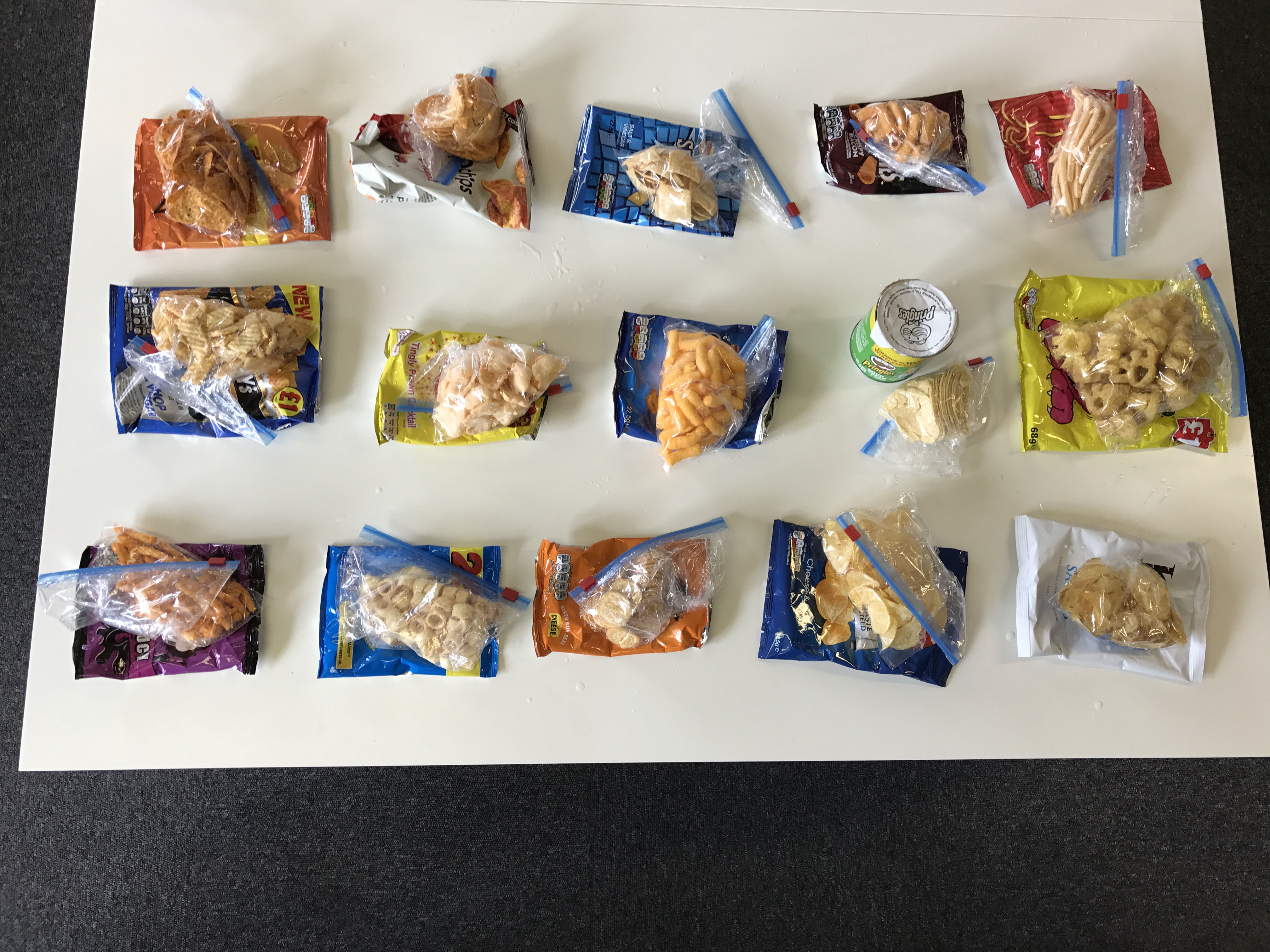
We decided the best way to see how much air was in a packet of crisps was by looking at the water displacement of an unopened crisp packet and the crisp contents in a vacuum sealed bag.

We put an unopened packet of crisps in a jug of water and measured the water level on the jug. We then removed the crisp packet from the water, popped the contents in a sandwich bag and vacuum sealed the content to remove any traces of air. We put the vacuum sealed crisps in the same jug of water, ensuring the water level was the same as when we put the unopened crisp packet in the jug, and then measured the water level again. Afterwards we compared the measurements and worked out the displacement.

We had the same water level per packet of crisps to make the experiment for that packet fair. We didn’t have the same sized crisp packets, as this wasn’t really possible, but we measured the packets against each other and compared them on a percentage basis, ensuring fair results.
The results:

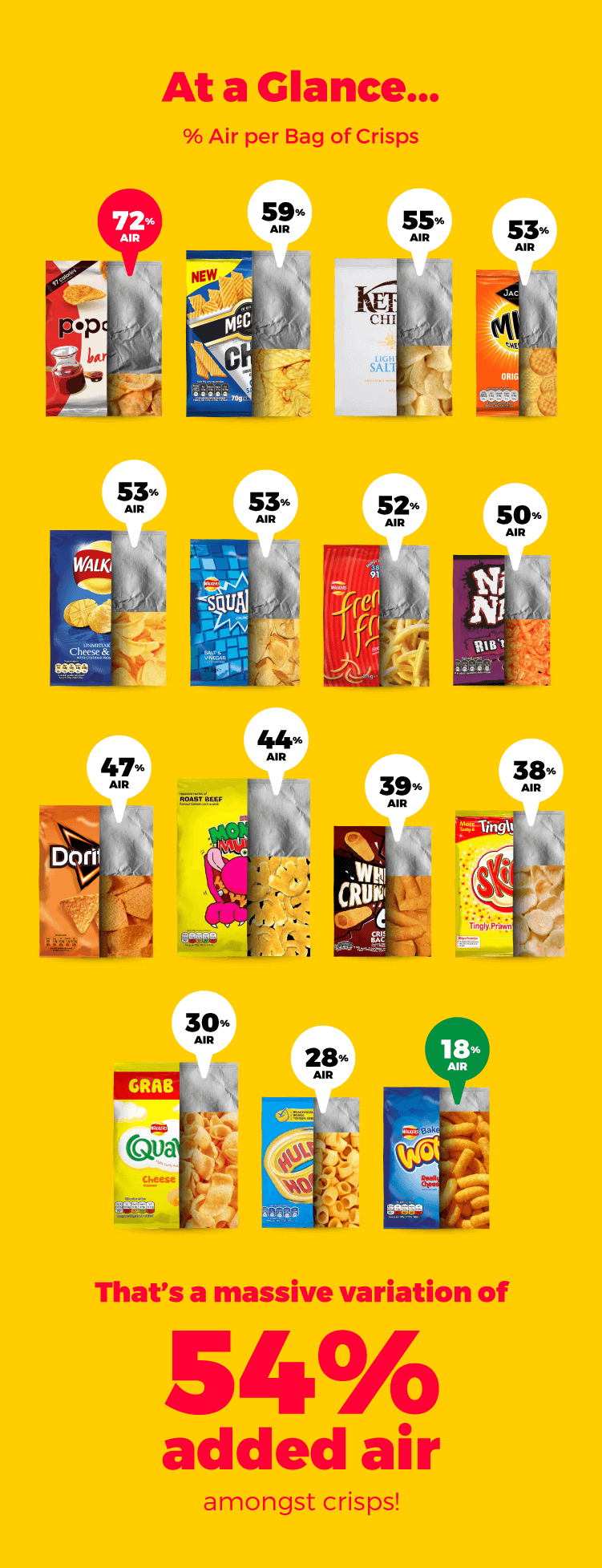
From most air in a packet to least, we have:

  • Popchips with 72% air. Before we opened the bag we wouldn’t have guessed these would be the worst offender but after we opened the bag, we did get a incline. It was immediately noticeable that there weren’t as many crisps in the packet as you would have expected. We also found Popchips to be the most expensive packet of crisps of the snacks we tested, retailing at £3.48 per 100g. We did compare prices per the amount of air and there wasn’t a strong enough correlation to suggest the amount of air and price were related, however Popchips did prove to be over a pound more expensive than any of the other crisps on a per 100g basis.
  • Pringles with 69.12% of air. We’ve took Pringles out of the running when making comparisons because the packaging is untraditional and conventionally incomparable.
  • McCoys crisps with 59% air.
  • Kettle Chips with 55% air.
  • Mini Cheddars with 53% air.
  • Walkers standard crisps with 53% air
  • Squares with 53%
  • French Fries with 52% air
  • Nik Naks with 50% air
  • Doritos with 47% air
  • Monster Munch with 44% of air
  • Wheat Crunchies with 39% of air
  • Skips with 38% of air
  • Quavers with 30% air. We do have to add a slight admission about our Quavers experiment. We got the numbers jotted down ok but upon double checking the numbers our Quavers had a minor leakage issue. Soggy quavers do not look appetising in case you were wondering.
  • Hula Hoops with 28% air.
  • Wotsits with 18% air. These had the least amount of air in the packaging, with a whopping 82% of actual crisps in the bag. Wotsits we salute you.

Brand Comparisons

To delve into this topic further, we decided to do a brand comparison and look at how much air was added to crisp packets by the different manufacturers. We wondered if some brands were worse offenders than others, and we also wanted to discover how much air was necessary on average for a typical packet of crisps.

Some manufacturers do dominate the crisp industry, KP and Walkers have a variety of bestselling and popular crisp brands in their groups. We featured 7 types of Walkers crisp brands and 5 KP crisp brands. We didn’t choose crisps on a brand basis, we chose crisps based on their popularity status, so this gives you an idea of their monopoly of the crisp industry.  When we compared Walkers and KP products we did draw an interesting and unexpected conclusion. On average, they added a similar amount of air into their crisp packets. Walkers added 42.37% on average and KP added 42.63% – it can’t be coincidental that the two largest crisp manufacturers add the same amount of air on average to their packets, so we reckon from our research this is an appropriate amount of air to add to the crisps.

We found that independent crisp brands, with less of a monopoly on the industry, added more than this average and perhaps an unnecessary additional amount. Jacobs added 52.63% air, Kettle Foods added 54.55% and Popchips added 71.88%.

But is it air in your crisps?

The answer is actually no. The gas you find in your crisps, while you might expect it to be air, is actually Nitrogen. Crisp manufacturers state they add nitrogen to their crisp packets to expel air, which otherwise would turn your crisps stale. Nitrogen is added to preserve the freshness of oven baked crisps and expand their best before dates. It is also added to protect the crisps – the nitrogen is meant to stop the crisps banging together and breaking in the packet while in transit.

Now being slightly cynical we decided to test both reasonings because let’s face it how many broken crisps do you often find in your packets?

Comments from the crisp manufacturers:

We were going to contact a representative from the crisp manufacturers but we found the answers to our questions about their packaging readily available on their websites.

Walkers claimed the Nitrogen was for protection of the crisp.

“Our packets of crisps are filled by weight.  You should always find that the packets weigh the grammage stated on the packet. However, there is a very good reason for the packets not being filled right to the top. Crisps are very fragile and can get crushed very easily. To try and prevent this from happening, we put air in the packs before they are sealed to act as a cushion for the product during transit. This does mean that the packets have to be a bit bigger than the contents.”

Source: Walkers.co.uk

KP have made efforts to reduce their packaging by 11%.

KP claim they have reduced the amount of packaging they use when producing their crisps. The ‘introduced multi-flow technology’ which enables them to make a more ‘compact packet size’. They also state their packaging is entirely clear with reference to contents, the weight is in fact stated on the packet.

Source: Kpsnacks.com

Popchips claim the Nitrogen is to keep the crisps fresh and crispy.

“Our special air-tight bags help make sure popchips stay fresh and crispy.” They do however also repeat on their website that they add no preservatives to their crisps.

Source: Popchips.co.uk

So in summary the main claims for adding Nitrogen are to protect the crisps from damage and preserve the contents for longer.

Further research and a second experiment:

In regards to the best before dates, we checked out all our packets and found that the majority had less than 55 days of use from their best before date. We would perhaps expect longer use for the amount of air added, but that is arguable.

In regards to the broken crisps, we decided to conduct another experiment and throw some Popchips out of the window. Bear with us, there was a method in this madness. We bought some more unopened packets of Popchips. We opened two packets, put the contents of one in a bag filled with air and the contents of the other in a vacuum sealed bag. We counted the contents before, evened out the numbers and removed any broken crisps before to make this experiment fair.

We then threw both bags out of the window and measured how many crisps were broken after a fall from a second floor window. The results? The vacuum sealed bag had one less broken crisp compared to the air tight bag.

4/14 chips were broken in the inflated bag after falling.

3/14 chips were broken in the deflated bag after falling.

So, are crisp manufacturers misleading us?

Some are, some aren’t but it is arguable whether you can stake your claim to make them change their ways when they do list the weight of the crisps on the packaging. Having said that, USA Today reported that two people were suing Wise because their crisp packets were less than half full.  

It is certainly true that some crisp manufacturers are adding more Nitrogen that necessary and as a result you are getting less crisp content, and in the case of Popchips if this is the case why are they charging you more than most. I guess that’s a question for them. Looking at the brand claims, the result of our experiments and comparing manufacturers however, it seems 42% of nitrogen is a good industry average for packaging and any more than that, you are losing out.

How did you favourite crisps fair?
how much air is in your crisp packet

Fast Food: Where It All Began

The largest fast food chains are global franchises, with multiple restaurants in most towns yet alone in each country. We decided to take them back to basics however by looking at the origins of the fast food giants. We have mapped out the first ever restaurants of your favourite fast food chains and told the story of how they were created. We also did some research and uncovered some interesting facts about the fast food giants so explore our map and unearth the surprises that are waiting for you. 

Click Here to View the Entire Map in Full Screen.

Alternatively, you can view our infographic.

Origins of the most popular fast food restauarants

The Origins Of The Most Popular Fast Food Restaurants

McDonald’s

First up on our list, we have McDonald’s. It started in 1940 when two brothers called Richard and Maurice McDonald opened up a drive-in barbecue restaurant. The brothers, Dick and Mac, had a food stand called the ‘Airdrome’ before where they sold hot dogs but they expanded their menu and McDonalds Bar-B-Q was born in 1940. They played with the menu several times during their early days but in October 1948 they streamlined the menu into a fast food concept and changed the name to just McDonalds. In 2016 a film was released about the origins of McDonalds and how Ray Kroc built the restaurant into the global franchise we know today. The origins however starts off with two brothers in San Bernardino, California.

Subway

Subway may not be thought of as a global fast food chain, it is often underrated, but they have almost 45,000 restaurants today around the world. Not bad to say the sandwich shop started as a side project to fund Fred DeLuca’s education.

KFC

Harland Sanders had many jobs in his lifetime but when he bought a service station in 1930 and started selling fried chicken to hungry drivers, he found his calling. KFC have over 20,000 restaurants today and are the most popular chicken joint around the world.

Dunkin’ Donuts

When William Rosenberg served food in factories and to construction site, he discovered people had a real taste for donuts and coffee. Fast forward almost 70 years and Dunkin’ Donuts is a popular global franchise.

Wendy’s

Dave Thomas had two major loves; his family and food. He combined the two in 1969 and Wendy’s was born. A family-friendly restaurant that uses fresh ingredients, serves fast food and excels in customer service; his ambition has led to numerous restaurants around the world. If you take a look at our map you may be surprised to discover who Dave partnered with before the birth of Wendy’s.

Pizza Hut

After watching the success of McDonald’s and KFC, Dan Carney, who had an interest in franchising from studying his business degree, alongside his brother decided to open a pizzeria called Pizza Hut.

Wimpy

Wimpy had the ability to be one of the largest fast food chains around the world. Edward Gold took America by storm with his Wimpy Grills restaurant in 1934 and 20 years later he had sold a license to J.Lyons to franchise the restaurant in the UK before taking it global. Unfortunately, America’s version of Wimpy died with Gold in 1977 and the UK’s restaurants are in fast decline. Wimpy still has a popular presence in South Africa but their early success is now a thing of the past.

Nando’s

One of the few big chains to start outside of America, Nando’s originated in Johannesburg in 1987. There was a chicken restaurant in Rosettenville called Chickenland and when Fernando Duarte took his friend there for dinner; they decided they like the piri-piri chicken so much they needed to buy the business. From here, Nando’s was born and the rest was history.

Five Guys

What do you do if your mum tells you to ‘start a business or go to college’? You set up a global fast food franchise. Five Guys only opened in 1986 but their ‘peanut oil’ fries and customisable burgers have proved a big hit around the world.

Starbucks

Jerry Baldwin, Zev Siegl, and Gordon Bowker opened a coffee shop in Pike Place market in Seattle in 1971, selling coffee made from the highest quality beans. When Howard Schultz joined in 1982 he helped them move from a coffee shop to a coffee bar/cafe and well the rest is history. Starbucks now have over 23,000 restaurants around the world are one of the most popular go to coffee makers.

You can see the full version of the map here. If you want to share the map or use any of our information, please include attribution to us – UK household appliance manufacturer, CDA.

How do you cook? Six cooking styles you might recognise

Share this Image On Your Site

Everyone is different when it comes to food. Some people like spicy food, some people have a sweet tooth and others may be more prone to a traditional roast dinner. With different food tastes comes different kitchen styles. Some people like to spend hours in the kitchen cooking up a treat while others might go for the quick and convenient option. We’ve put together some characters that describe the different styles of cooking we see everyday in our kitchens.

This is a light-hearted look at the different cooking styles so please don’t take any offence from our characters. The next time you are in the kitchen however have a look and see if any seem familiar. 

Hot Head

The Hot Head character is the confident cook who knows what they’re doing. They cook a mean spag bol but that’s not without a lot of blood, sweat and tears. The hot head is someone who likes to be in control, yet gets stressed very easily. The air might be a little blue and it’s probably best to avoid the kitchen at all costs when this chef is cooking, but you’ll get a pretty good meal at the end of it.

Outside of the kitchen the Hot Head tends to be hardworking and competitive. They are motivated individuals who are confident and blunt – they are not afraid to get their opinions heard. They tend to have a strong, extrovert personality with a sarcastic humour. They also tend to be quite charming and loyal.

Kale Queen

The Kale Queen is the healthiest of eaters. They love throwing the most random ingredients in a smoothie maker and cooking up some healthy deliciousness with the freshest ingredients from the local food market.

Outside of the kitchen the Kale Queen loves being active and spending time outdoors. They love yoga, going to the gym and hiking through picturesque green surroundings. They are often a calm and peaceful individual, the complete opposite to the Hot Head. You will often find the Kale Queen proudly instagramming her dinners or unwinding with an adult colouring book.

King of the Grill

The King of the Grill is exactly that; he is obsessed with the barbecue and won’t hesitate to get it out come rain or shine – that is what umbrellas are for right? Normally this guy wouldn’t cook but any excuse for a beer and a burger and the grill comes out. You will often find him wearing a cheesy apron that his wife or children bought him for one of the holidays – which they celebrated of course with a barbecue.

The King of the Grill likes to spend his spare time doing odd jobs around the home. He is very house proud and enjoys DIY projects.

Bake Off Wannabe

The Bake Off Wannabe dreams of being a domestic goddess but unfortunately her kitchen attempts often end in disaster. The Bake Off Wannabe watches all the cooking shows, spends hours of each day scrolling down Pinterest looking at amazing cakes and she owns all the kitchen gadgets. Unfortunately, her creations never quite look the way they should and she either sets the smoke alarm off or resorts to packet mixes.

The Bake Off Wannabe is optimistic and creative. She loves spending time with her family and is really friendly. She is a great person to be around – except maybe when she’s cooking.

Recipe Purist

The Recipe Purist is methodical and loves to-do lists and recipe books. Every meal they prepare comes out exactly as planned because they never stray from the instructions. The Recipe Purist eats quite healthy, they make sure they have all the recommended food groups on one plate and in the correct portion size.  

The recipe purist maintains a controlled approach outside of the kitchen. They rely on lists and sticky notes to guide them through their day. You can imagine what their fridge looks like, everything neatly aligned and compartmentalised. They are always on time and they are super organised. They have the cleanest of homes, which can be intimidating if you go around for dinner – just make sure you are careful of your crumbs.

Taste Bud Tester

The Taste Bud Tester is the most dangerous of all cooks. They won’t set your smoke alarm off but they will set your mouth on fire. The Taste Bud Tester loves spicy foods and they use their creative nature to experiment with a full range of herbs, spices and chillies. Their cooking motto is the hotter the better so you need to be feeling very brave to sit at their dining table.

Outside of the kitchen the Taste Bud Tester is adventurous and outgoing. They love trying new things and being experimental. They love to travel and try new foods. Extreme sports are exhilarating to them so be careful if you suggest skydiving, bungee jumping or rock climbing – they will almost always be game.

Which hob is best for the job?

In our latest ‘just for fun’ guide we measure up our different styles of hob to help you choose which one to go for. We’ve got insider information to give you the facts on what is good about each hob fuel type and what style of cook it suits best. Time for the showdown…

How many colours are in your candy?

how-many-coloured-sweets-in-a-bag

Share this Image On Your Site

Have you ever opened a packet of sweets and wondered why there seems to be so few of your favourites? Many people often feel this way, but is it just coincidence, or plain bad luck? We bought lots of the nation’s favourite sweets and decided to put the theory to test – do you get more of certain sweets in a pack or is there an even split?

Skittles

The first sweet under investigation was skittles. We bought several packets of traditional 55g packs and counted how many of each coloured sweet you get per pack. Green was the most popular colour on average followed closely by orange. We discovered that the average packet includes 52 skittles with thirteen being green and twelve orange. Purple and red were the least common sweets in the pack with eight red skittles and seven purple. It is difficult to tell what everyone’s favourite skittles are but according to this survey by Tellwut, strawberry was top of the charts. If this is true then you are actually getting a lot less of your favourite. The same survey however did show lime to be the second favourite and we found that to be the most common.

Wine Gums

In an average 52g pack we found there to be twelve sweets on average. 25% of the pack seemed to be dedicated to the red sweets whereas we found there to be an even split between the rest. In analysing our packs we also recorded the number of all sweets in any given packet and out of twelve sweets, one packet contained seven red sweets. Our wine gum experiment seemed to show a clear favourite but does this match what the nation wants? Cadbury’s themselves reported 80% of people preferred red and black wine gums so assuming that’s true, wine gums are delivering what you want.

Fruit Pastilles

In an average 52g pack of fruit pastilles we found you get 14 sweets, split into the colours red, green, purple, yellow and orange. We found green to be the most popular with four sweets on average per pack. Green pastilles was also the most common colour in a single packet having found more than half (eight) in one packet.

Gold Bears

Haribo Gold Bears are a popular sweet choice but how do they fair in our colour comparison? A 100g bag was found to contain 43 gold bears on average and there did seem to be a more even split between the various coloured sweets. There was an even number (eight) of red, gold and green bears. White bears were close behind with bags containing seven on average – we also found the most number of white bears in a single pack.

Jelly Babies

An average 350g bag includes 45 jelly babies and on average red and yellow sweets were found to be the most common. We also found more red sweets in any single pack than any other colour so from a jelly babies point of view, if red is your favourite then your all set. If you know the stories of the jelly baby bears however this might not come of any surprise. When Cadbury Schweppes took over the brand in 1989 they gave each bear a name and character story – the red bear is called Brilliant and he is noted as leader of the gang. 

Starburst

Starburst were the sweets that had the most even split out of all the sweets we tested. In an average 192g bag, we found 43 starbursts in a pack – eleven red sweets, eleven purple sweets, eleven orange sweets and ten green sweets. All pretty much even so no evident favouritism.

So if you want a fair chance of getting your favourite coloured sweet you’re best of buying Starburst or Gold Bears. Skittles, Fruit Pastilles and Jelly Babies were found to contain more of certain colours which is great if you like their favourites. If your favourite is one of their rarer colours however your only option is to buy more sweets and hope for the best.



